Why Your Brain Sometimes Sees Things That Aren't There
Faces in toast, figures in the dark, shapes on a blank wall. Seeing things that aren't there isn't a glitch. It's what happens when a brain built to predict gets a little too confident.

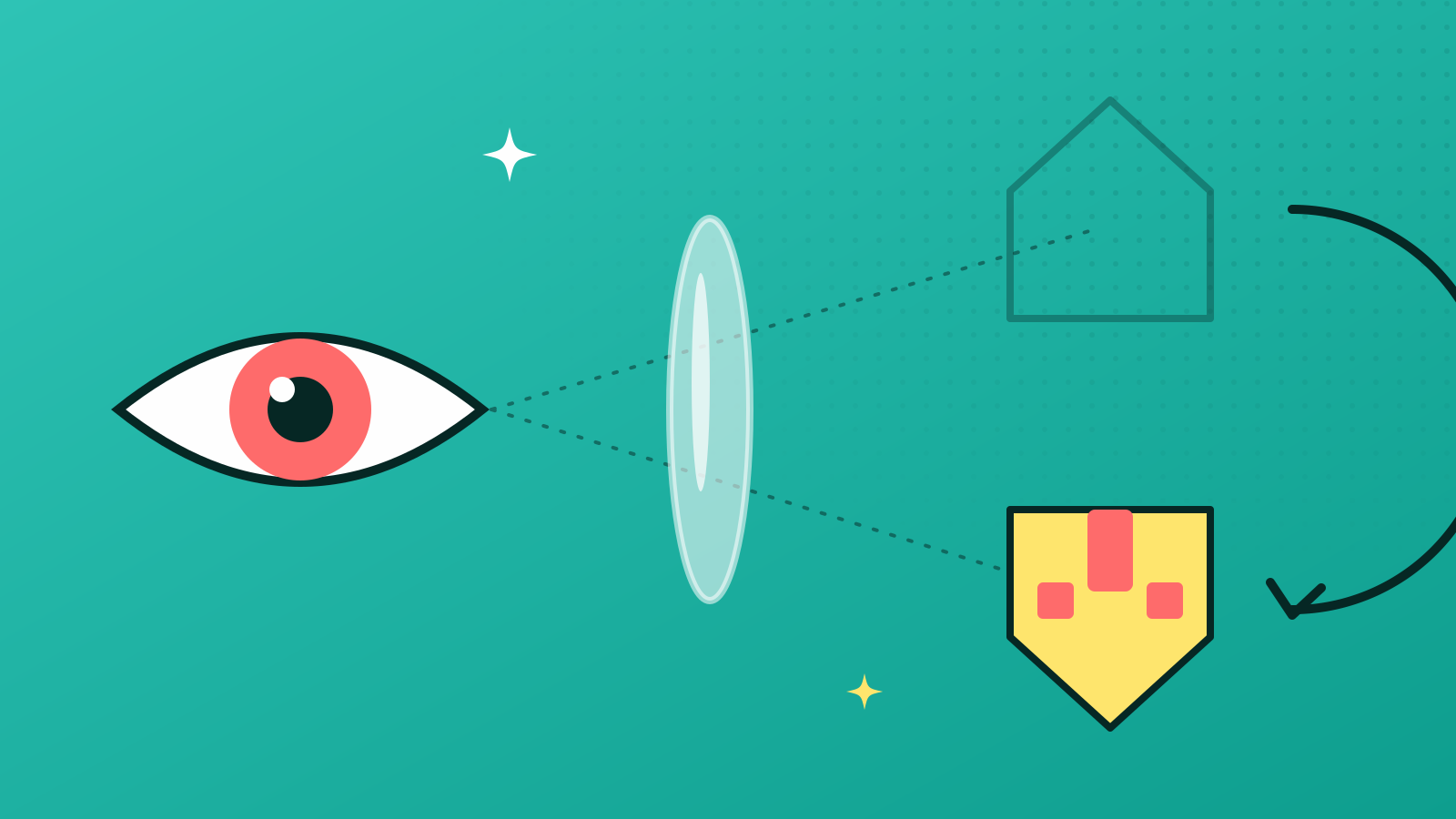
Stare at an electrical socket for long enough and it starts looking back at you. Two eyes. A little mouth. Maybe a hint of surprise. You know it's a piece of plastic, and you still can't un-see the face.
That tiny "wait, is that…?" moment tells you a lot about how your brain works. Seeing isn't like a camera recording the world. It's more like a running guess about what's out there. And sometimes the guess shows up before the evidence does.
Your brain guesses first
For a long time, vision was usually explained as a one-way assembly line. Light hits your retina, your brain picks out edges, edges become shapes, and shapes become objects.
That picture leaves something out. A popular framework called predictive processing says your brain also works the other way round. It keeps making predictions about what it's about to sense, then checks them against what actually comes in. Philosopher Andy Clark's 2013 review in Behavioral and Brain Sciences helped bring the idea to a wide audience.
When the signal is clear, your guess and the world agree and you never notice anything. When the signal is weak, noisy or ambiguous, your expectations get more of a say. That's when things show up that aren't really there.
Faces everywhere
The most famous version of this has a name: pareidolia. It's when you see a meaningful pattern, usually a face, in something random.
In a 2014 study in Cortex, researchers showed volunteers pictures of pure visual noise. Here's the trick. The volunteers were told that half the pictures had a hidden face or letter in them. None did. People still reported seeing faces on 34% of trials and letters on 38%.
Brain scans backed this up. A face-sensitive area called the right fusiform face area lit up when people "saw" a face in the noise, even though no face existed. The researchers concluded that face processing leans heavily on expectation. Give your brain the faintest hint of a face, plus a reason to look for one, and it'll often find it.
Monkeys see them too
You might guess that seeing faces in sockets is a quirk of a species raised on cartoons and emoji. A 2017 study in Current Biology says otherwise. Rhesus monkeys looked longer at photos of objects that people see faces in than at similar objects without them. Their eyes even moved over the fake "eyes" and "mouth" the same way they scan real faces.
That points to an old face detector we share with other primates. It's tuned to catch faces fast, not to avoid false alarms.
A quick first draft
So how long does your brain buy the illusion? A 2020 study in Nature Communications tracked it moment by moment with brain imaging. At first, illusory faces were handled more like real faces than like ordinary objects. Within about a quarter of a second, that flipped, and the brain treated them as the objects they were.
So you really do "see" a face for a split second. Then a slower process files it under socket. The feeling of a face hangs around, but you're never actually fooled.
Why would a brain make mistakes on purpose?
Because some mistakes are cheap and some are expensive.
Missing a real face (a predator, a rival, a parent) could cost you a lot. Mistaking a rock for a face costs you a second look. If those are the stakes, a detector that's sensitive first and picky second makes sense. The 2020 study describes the system as one that "privileges sensitivity over selectivity".
When there's almost nothing to see
If your expectations fill gaps in noisy input, what happens when there's barely any input at all?
Researchers have tested this with the Ganzfeld ("entire field") technique. You look into a plain, featureless field of light, often with halved ping-pong balls over your eyes and steady background noise in your ears. A 2008 review in Cortex describes how most people start to see pseudo-hallucinations. Some see simple patterns. Others see vivid, dream-like scenes.
The same review is openly skeptical of one popular use of the technique, so-called "Ganzfeld telepathy" experiments. It argues they rest partly on unsupported ideas about what the Ganzfeld state even is. The hallucinations are real experiences. Claims about mind-reading are a different story.
When eyesight fades
There's a medical cousin of all this. Charles Bonnet syndrome makes people who've lost a lot of their sight see things that aren't there, like patterns, shapes, people or places. The NHS says it's often linked to eye conditions such as age-related macular degeneration. And it's not a sign of a mental health condition.
One common explanation is that the visual system starts making its own activity when it gets less input. If you or someone close to you starts seeing new hallucinations, talk to a doctor or optometrist. This article is here to make you curious, not to diagnose anything.
Try catching your brain in the act
You can watch your own guessing machine at work:
- Look at textured surfaces in dim light. Wood grain, clouds and carpets turn into faces much more easily when there's less detail.
- Notice your double takes. That half-second where a coat on a hook looks like a person is the fast first draft, right before the correction.
- Tell a friend what to look for. Once someone says "there's a face in that tree", try not seeing it. Expectation changes perception.
Next time a socket smiles at you, you'll know what's going on. Your brain made a bet, lost it, and fixed it in about a quarter of a second.
Sources
Fact-checked and editorially reviewed on .
- Seeing Jesus in toast: Neural and behavioral correlates of face pareidolia, Cortex (Liu et al.), 2014
Volunteers 'saw' faces in pure visual noise on 34% of trials.
- Face Pareidolia in the Rhesus Monkey, Current Biology (Taubert et al.), 2017
Monkeys look at illusory faces the way they look at real ones.
- Rapid and dynamic processing of face pareidolia in the human brain, Nature Communications (Wardle et al.), 2020
Illusory faces are briefly processed like real faces, then reclassified within ~250 ms.
- Whatever next? Predictive brains, situated agents, and the future of cognitive science, Behavioral and Brain Sciences (Clark), 2013
Influential review of the predictive-processing framework.
- Ganzfeld-induced hallucinatory experience, its phenomenology and cerebral electrophysiology, Cortex (Wackermann, Pütz & Allefeld), 2008
A uniform, featureless visual field produces pseudo-hallucinations in most observers.
- Charles Bonnet syndrome, NHS
Visual hallucinations that can follow significant sight loss.
Spotted an error? Tell our editors.